
Introduction
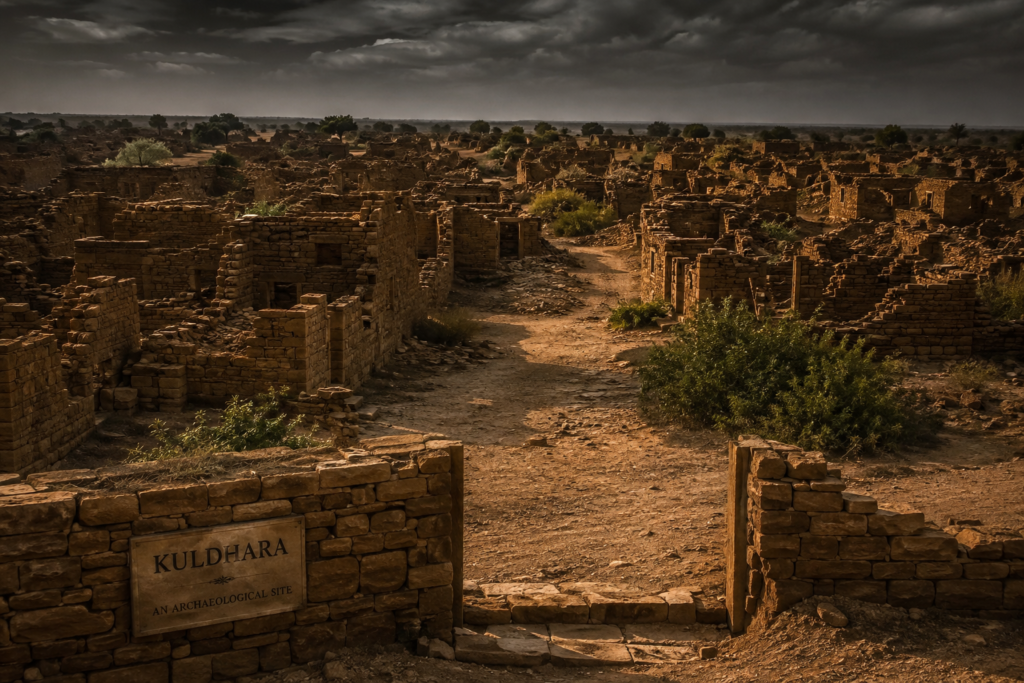
One of the most interesting places in Rajasthan you would like to visit in the future is the Kuldhara village – the
ancient ruined village near Jaisalmer city. Situated on the borders ofthar desert Kuldhara is full of mysterious stories
about a total abandoned place, a historical event which happened ages ago in sudden way with the all thehabitants,
pressures and also the legends of curse by some paranormal force of nature . The village remains a mystery of it is
abandoned in a single day and is still in ruins until this day..you can walk through the village and see the
ancient mudhuts and stones that constitute a long lost society!
You may think of kuldhara as the haunted village.
If not then it surely have to be for a desert traveller in 21 century with the most richest heritage of palliwal Brahmans.
Location of Kuldhara Village

Kuldhara is located 18-20 kilometers south- west of Jaislamer (Rajasthan). Kuldhara stands amidst the arid desert of the Thar; sand, rock, sharp thorns, thorny trees and an intensely hot climate comprise the elements characterizing the place.
Its seclusion contributes to Kuldhara’s eeriness. It’s neither a contemporary town with traffic, a plethora of stores and people nor anything of that nature. It consists of an abundance of abandoned ruins stretched across long, vacant paths and tracts.
The Ancient History of Kuldhara

It is believed that Kuldhara was founded sometime during the late 13th century by the Paliwal Brahmins. A community that has extensive understanding of agriculture, trade, water resources, and settlement planning. The conditions in the Thar Desert are extremely harsh – scarce rainfalls, extremely high or low temperature
ranges and scarce water resources – the scarcity of which makes it one of the most valuable resources.
Nevertheless, the Paliwal society developed systems that enabled them to create and sustain successful and
flourishing settlements such as Kuldhara, one of the settlements established in the Jaisalmer region.
The village did not have to be an unplanned structure of buildings. In addition to a streets, it was also comprised of houses, wells, temples and courtyards. These remains of the former village represent evidence of the architecture
and societal structure of the settlers that once inhabited it.
Who Were the Paliwal Brahmins?
The Pardeshi Brahmins were key players in Western Rajasthani History . They were traditionally farmers and traders and became highly regarded for their endurance in hostile desert lands . They also had the ability to cultivate land with the harsh water conditions and knowledge of the local topography to use it resourcefully .
Water harvesting techniques , domestic construction and settling in a way to be comfortable even in extreme climate have been a strength of this clan .
They were a major contributor to prosperity and to setting up townships like Kuldhara.
The Mysterious Abandonment
The greatest mystery of Kuldhara is straightforward, too;
Why did the locals flee their village of Kuldhara?
If folklore and tradition are to be believed, then both Kuldhara along with multiple adjacent villages were abruptly abandoned on the exact same day circa early 19th century. How that happens, though, is still a matter of speculation. Why these individuals vacated is something people still cannot decide on.
Some accounts attribute their migration to political harassment, the extortionate taxes, an abrupt scarcity of water, environmental degradation.
However,the best explanation widely cited-is this one concerning Salim Singh the tyrannical Diwan of Jaisalmer.
The Legend of Salim Singh
Which, as it stands, was indeed Salim Singh, a very influential diwan ( minister ) and of course, he was very much impressed by the lovely Daughter of the Village. The old villagers were not interested in giving over any daughter to any Diwan and when approached by the villagers to refrain himself from that attempt, Salim Singh is supposed to have threatened the community. So, they ask for some time and out smart him.
They decided that rather fall into the hands of Diwan than be put into harm’s way in their own Village, they pack their belongings in the night, and leave Kuldhara and adjoining villages.
They put a curse and nobody from the village ever could live and settle in this place permanently. Hence Kuldhara became, “the village of ghosts”. This was just a part of local legends and folklore and no historical account as such is available proving to the each and every line of that story, but such are local Legends that have come down the ages.
The Theory of Heavy Taxation
One very practical reason given for the forsaken towns: Taxes and economic squeeze. The Paliwal communities weren’t merely passive desert dwellers; they had been active in trade and their lands were profitable. If taxes rose drastically in the area, the economic incentives for living in a harsh desert environment might have shifted.
The settlers and inhabitants might have felt, rationally or emotionally, that their economic security lay somewhere else.
Since other settlements might have been subject to similar pressure and exodus at roughly the same time, the departure of all of them from Kuldhara and other nearby towns may explain their concurrent fate. A great ghost story is lacking with this interpretation, but one may just have happened to become popular at that particular time.
The Water Shortage Theory
Another significant aspect to consider is the importance of water.
Any student of the Thar Desert history will know that obtaining water was essential to the life of the settlement. Kuldhara relied on a carefully managed water system. Therefore even a minor variation in the groundwater or amount of rainfall would have a significant impact on agriculture and daily life of the village.
A gradual depletion in the available quantity of water would not have made the village economically unviable and sustainable.
No settlement can survive in a desert environment without easy access to water, so water-related changes are frequently cited as one of the plausible causes for Kuldhara’s desertion.
Environmental Changes
The desert environment is not static.
Over centuries, rivers, groundwater levels, rainfall patterns, vegetation, and soil conditions can change.
A settlement that was economically successful several centuries ago may become difficult to maintain if environmental conditions change.
Some theories suggest that changing environmental conditions contributed to the decline of Kuldhara and other Paliwal settlements.
However, researchers do not have enough evidence to say that environmental change alone was responsible.
It may have been one factor among several.
The Architecture of Kuldhara

Architecture of Kuldhara This is one of the highlights of visiting Kuldhara. Built of stone, mud and other building materials which are found abundantly in the vicinity, many of the Kuldhara houses included courtyard in the centre and built with heavy thick walls for the residents to get protection from the intense heat of the desert. The streets of this village were orderly and there were separate residential blocks for villagers. At Kuldhara, one can still see: ruined houses stone walls door frame central courtyards abandoned wells ancient temples narrow, winding lanes larger residential compounds Although Kuldhara ruins may have been destroyed with time but they represent how disciplined Kuldhara village once used to be.
The Kuldhara Temple
Old ruins at Kuldhara Among the most important existing structures of the abandoned city of Kuldhara are the remains of temples and religious edifices These ancient buildings tell about the fact that the settlement wasn’t only a farming village. The inhabitants of the ancient village built separate places for spiritual purposes because religion and society were inseparable. You can see some remaining of interesting architecture and carvings which reflect the art and aesthetics of that age. The ancient structures on the other hand, add up to the mystical outlook of Kuldhara village.
The Legend of the Curse
Most likely, one of Kuldhara’s story’s most well known features has to be the curse it allegedly contains. Legend has it that the villagers left their homes that night leaving a curse of Kuldhara that nobody would ever successfully live in the village again. The curse supposedly ensures that anybody who tries to make their home in the village will face misery and bad luck which has been handed down as folklore ever since and even today tourists are still told that the curse is still in effect! Clearly, there’s no real proof to suggest the village was even cursed as such.
Why Is Kuldhara Considered Haunted?
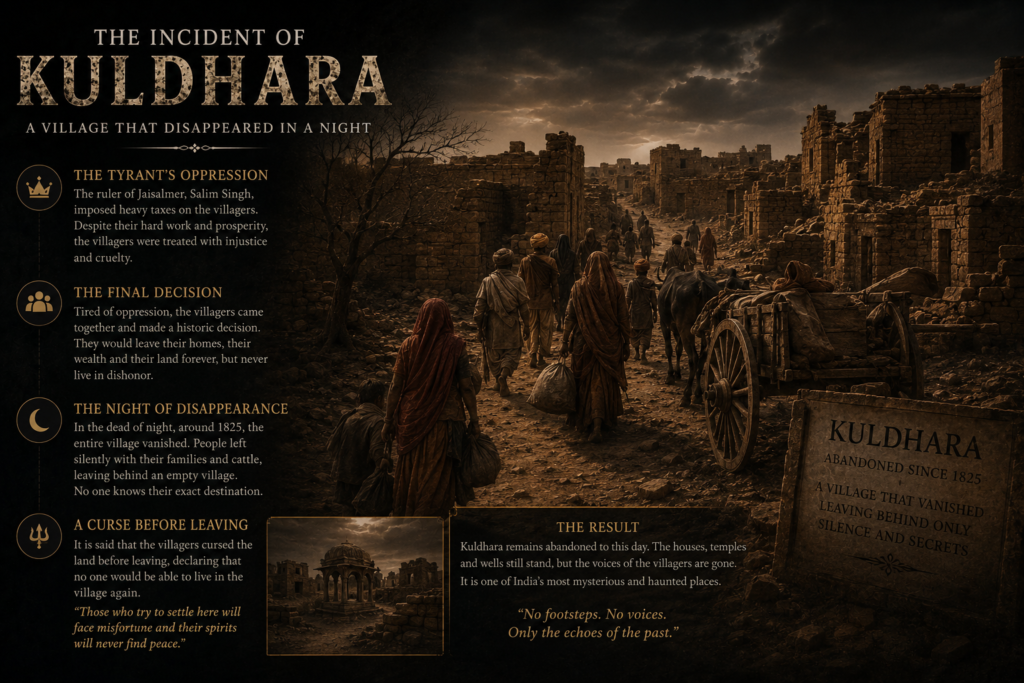
Due to its abandoned nature Kuldhara has an automatic eerie vibe. Its empty houses, decaying walls, deserted lanes, wind, and the setting of the sun at desert is a heaven to ghost stories and folklore. People and the locals often talk about: Footsteps in the quietude; Voices or whispers from nowhere; Seeing vague shadowy entities; Sense of being watched; Instant fear or uneasiness; Unidentified sounds from unused structures; Seeing abnormal movements far away; It is believed even invisible entities will pass through you on your visit. Nevertheless, these experiences are purely coincidental and personal!
Kuldhara at Night
The appearance of Kuldhara changes completely after sunset.
During the day, sunlight reveals the details of the ruins. Visitors can clearly see the old houses, roads, temples, and surrounding desert.
At night, however, the same structures can appear completely different.
The absence of modern buildings and heavy traffic creates an unusual silence.
The wind moving through ruined structures can produce sounds that resemble whispers or footsteps. Shadows from walls and vegetation can also appear distorted under artificial lighting or moonlight.
These natural factors, combined with the village’s frightening reputation, can make a nighttime visit feel extremely unsettling.
Paranormal Stories and Investigations
Due to this, Kuldhara has been visited by filmmakers, paranormal researchers, teams for tv, reporters and photographers. This particular group is attracted due to Kuldhara having been proclaimed as the most haunted place by many and this is being considered paranormal in form by them. They have Reported feelings, sounds and visions which have been referred asparanormal incidences and this paranormal report also has found its place in numerous articles related to haunted Indian locations andtv programsas online. Though there is quite an difference inreporting and establishing paranormal incidents, yet these paranormal experiences could possibly be very suitable fora mystery website, as these can be dealt under their respective sections i.e factual and non-factual.
Best Time to Visit Kuldhara
The most comfortable time to visit Kuldhara is generally between October and March.
During these months, the weather around Jaisalmer is much more pleasant than during the summer.
The summer months can be extremely hot, with temperatures becoming uncomfortable for extended outdoor exploration.
Winter mornings and evenings can be quite cool, while daytime conditions are generally suitable for exploring the ruins.
Conclusion
It is a city of history and mystery.
A city that once held a prosperious Paliwal population and was later abandoned leaving behind homes, temples, streets and many questions. The tale of Salim Singh and the supposed curse along with stories of the hasty leaving and paranormal legends makes this one of India’s most well known mysterious places. However while there is no scientific backing for the belief that this place is haunted one can certainly see how stories of the supernatural may have evolved from this place and it’s abandoned buildings.
Kuldhara may be the only place where you don’t have to compromise on either the mystery or the history.
The ruins show that something did happen here while the legends just tell us why the people fled their homes and what occured on that last night to make them.